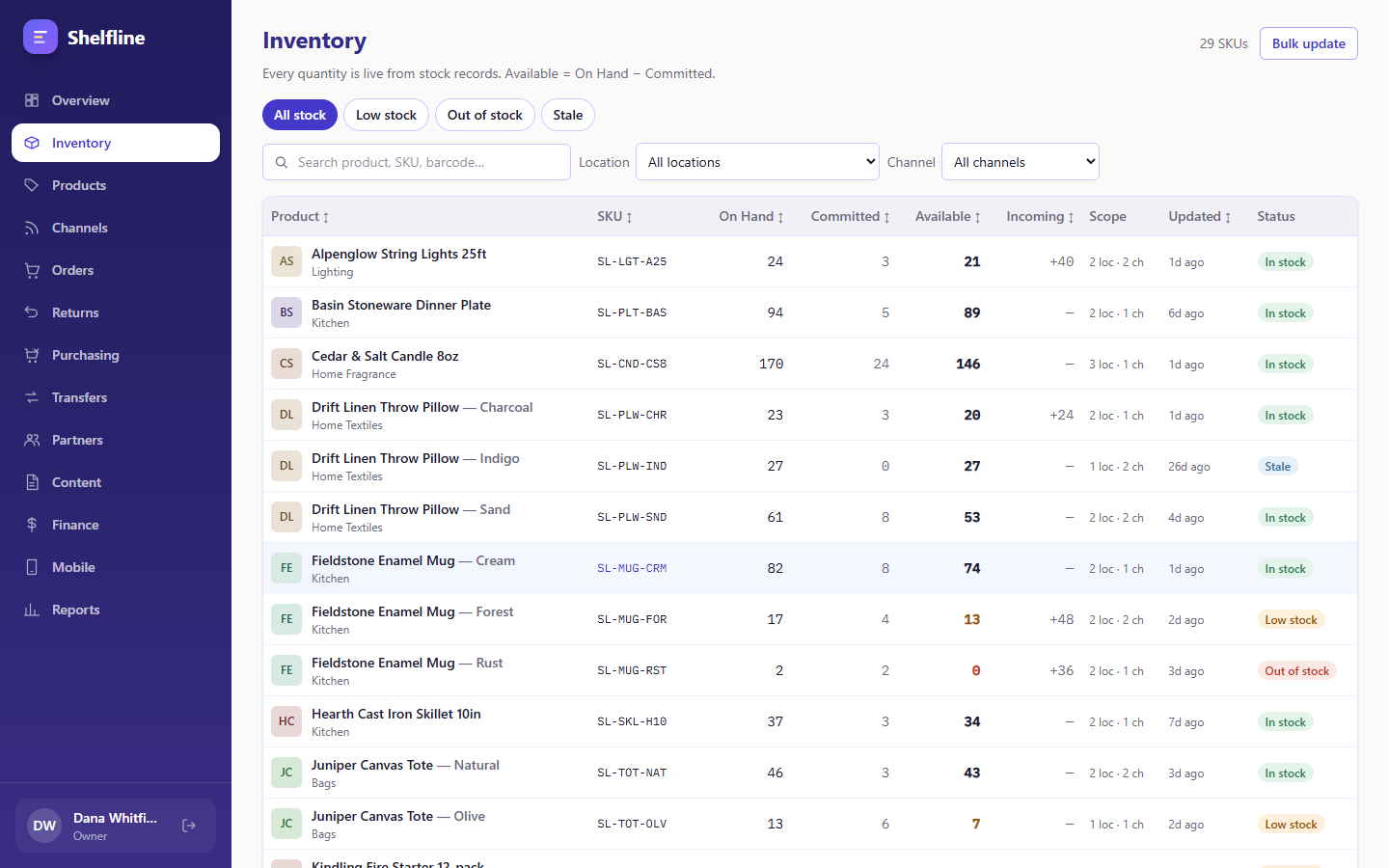
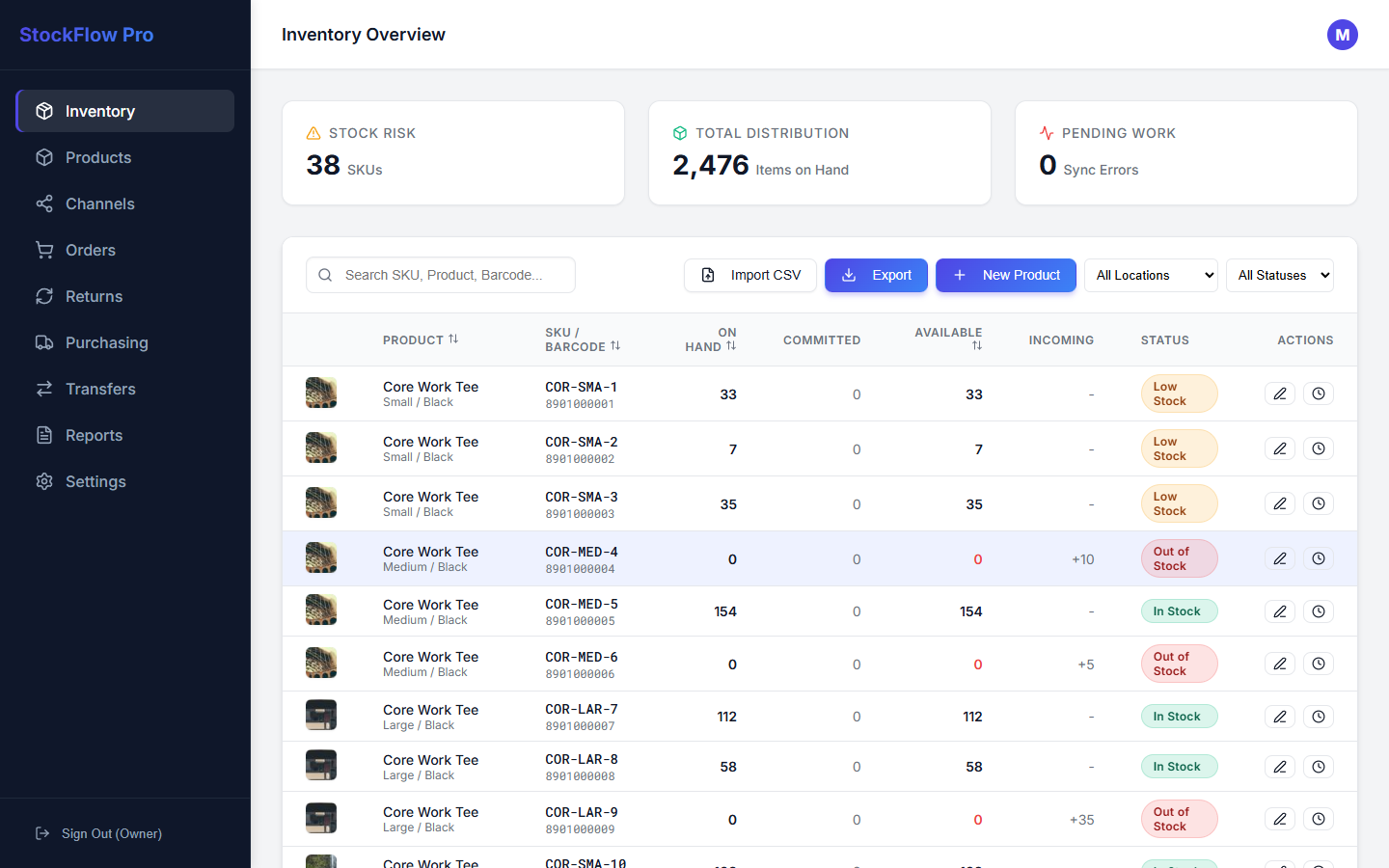
Ecommerce Inventory Management Planner
Turns a vague 'multi-channel inventory' prompt into an agent-executable spec — sellable-availability truth, sync with a real reconciliation queue, and order reservation that never oversells — researched across 97 live ecommerce inventory products.
The problem this kills
Ecommerce inventory apps that come out of AI-assisted builds oversell, drift, and lie about stock — in the same predictable ways. Available-to-sell is treated as one editable number instead of a computed value (on-hand − reserved − channel buffer + incoming), so orders keep coming in on stock that's already committed. Channel sync is fire-and-forget: it pushes a quantity, never reads it back, and when a marketplace rejects or lags the update there is no reconciliation queue — just silent divergence. Orders get ingested twice because nothing is idempotent. Bundles and kits don't atomically decrement their shared components, so a two-SKU bundle sells past the limiting part. Returns collapse into a single "restock" button with no receipt, inspection, or sellable-vs-damaged disposition. And a "connected channel" has no custody model — no baseline, no pause, no safe offboarding.
This planner exists to make those failures structurally impossible in the generated spec: quantity is a truth derived from movements and reservations, every channel publish carries a visible lifecycle (queued → sent → accepted → verified → failed → retried → reconciled), order ingest is deduplicated and reserves before it promises, and bundles reserve on the limiting component.
Why your agent cannot fake this
The planner is distilled from a research pass over 97 live ecommerce inventory products — Shopify inventory and Marketplace Connect, BigCommerce, and the multi-channel operations layer (Cin7, Linnworks, Sellbrite, Extensiv/Skubana, and their peers) — captured from first-party product pages, not marketing summaries. That corpus was normalized into 11 product families: channel connection and custody; catalog identity and listing mapping; the inventory-network quantity model (on-hand, reserved, unavailable, buffer, incoming, available-to-sell); synchronization with failure recovery and reconciliation; order ingest, reservation, fulfillment handoff, and cancellation; returns receipt, inspection, and disposition; bundles, kits, and shared components; replenishment, purchasing, receiving, and transfers; stock corrections, evidence, import, and export; operational intelligence and decision evidence; and governance and integration contracts.
Five capability areas are held out as explicit branch families — marketplace/FBA/3PL fulfillment, distributed order orchestration, preorder/backorder supply, dropship/vendor fulfillment, and listing/PIM/content syndication — so they are only built when a buyer selects them, never as silent Basic bloat. (Per-feature prevalence figures from the source corpus are being finalized through verification review before they are cited as counts; the taxonomy and the branch-gating are the deliverable today.)
Proven in a live build-off
This planner has been dogfooded end-to-end: six working ecommerce inventory apps were built from it by three coding models — GPT-5.6 Sol across four build lanes, Claude Opus 4.8, and Gemini 3.1 Pro. The five that reached deploy readiness run as live demos you can log into from this page. The planner is the product; the apps are the proof.
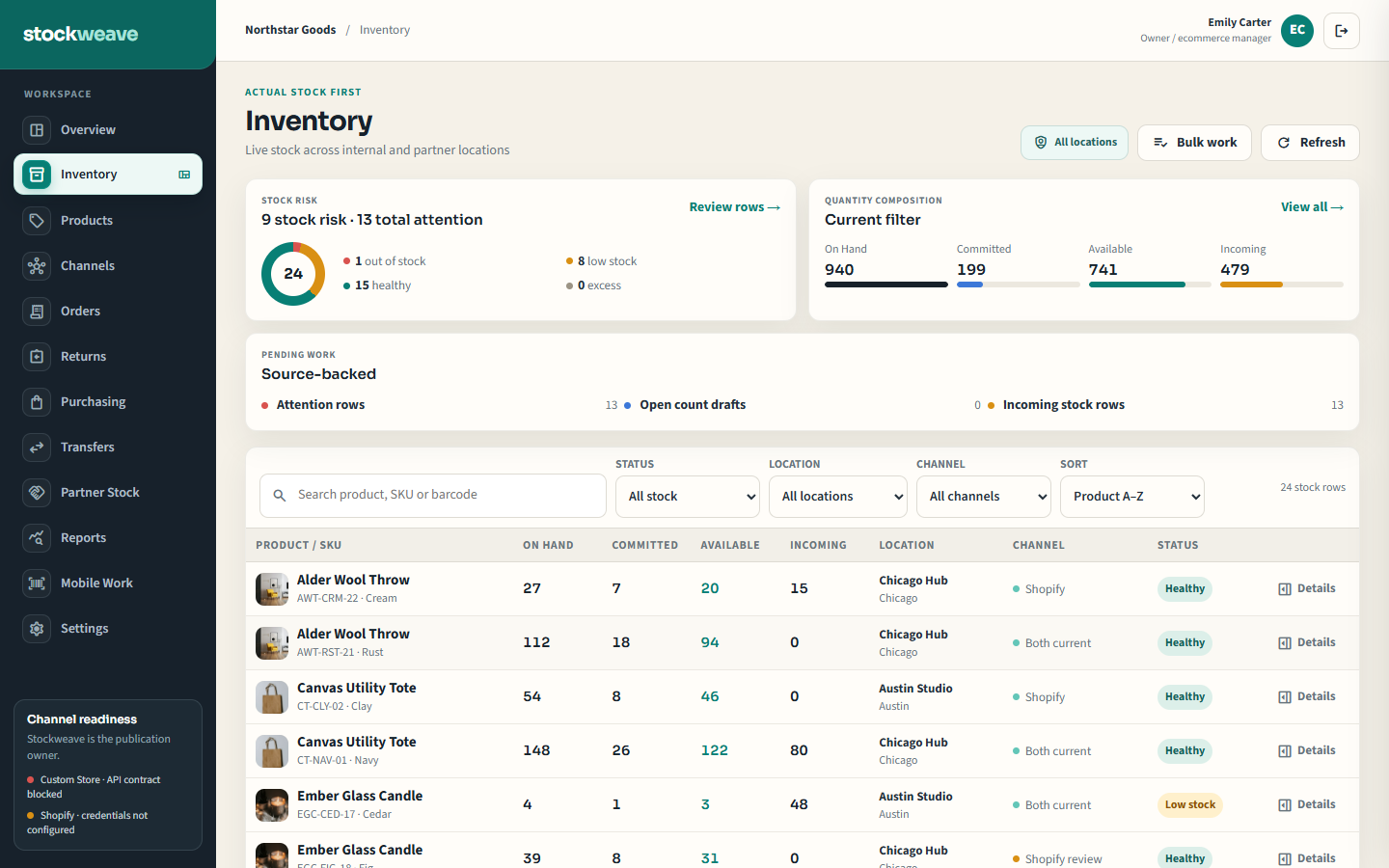 Stockweave — the strongest build of the set, with a six-dimension quantity model (on-hand, committed, available, incoming, in-transit, partner-held). Log into it live from the demos below.
What you actually get
A structured interview that forces the ecommerce-shaped decisions before any code is written: how many sales channels and which ones, whether stock is single- or multi-location, the exact quantity model (does available-to-sell subtract reserved and channel buffers, is incoming tracked), how sync failures surface and reconcile, whether orders reserve on ingest, roles and tenant/location scope, bundles and shared components, the replenishment-to-receiving loop, returns disposition, and which of the five advanced branches are in scope.
After discovery, a forbidden-family scan keeps adjacent scope out unless you explicitly select it: full POS retail, warehouse execution (bins, pick/pack, putaway), manufacturing/BOM, and accounting ledgers are boundary or branch families — they belong to their own planners and do not leak into an ecommerce stock build.
The output is one complete, tool-aware build spec — CLAUDE.md for Claude Code or AGENTS.md for ChatGPT Codex — with build steps that name the tables they touch, the screens they produce, seed data, and a hard acceptance gate before the next step begins.
Coverage
Basic: canonical products/variants/SKUs, one or more sales channels with a real connection/custody state, the derived quantity model (on-hand, reserved, available-to-sell, incoming), publish-and-read-back sync with a reconciliation queue, order ingest that reserves stock, reasoned adjustments and counts over an immutable movement ledger, low-stock review, reports with real CSV exports, and an operations dashboard whose every tile drills to source rows.
Moderate adds: SKU alias/mapping across channels, multi-location and transfers, the replenishment → purchase-order → receiving loop, bundles and kits with shared-component reservation, returns receipt and disposition, and import/export at scale.
Advanced covers the branch families — marketplace/FBA/3PL custody, distributed order routing and promise optimization, preorder/backorder selling, dropship/vendor fulfillment, and listing/PIM/content syndication — each gated behind an explicit buyer selection.
Full POS, warehouse execution, and manufacturing stay out — by design.
Real apps this planner built.
Each one is live — sign in and try it. Compare all 5, with their scores →
LiveStockweave
The most complete build of the set — a six-dimension quantity model (on-hand, committed, available, incoming, in-transit, partner-held), server-enforced roles, honest channel-readiness that names blocked connectors, and the deepest evidence trail: Northstar Goods across Chicago + Austin, Shopify + Custom Store.
Open live demo →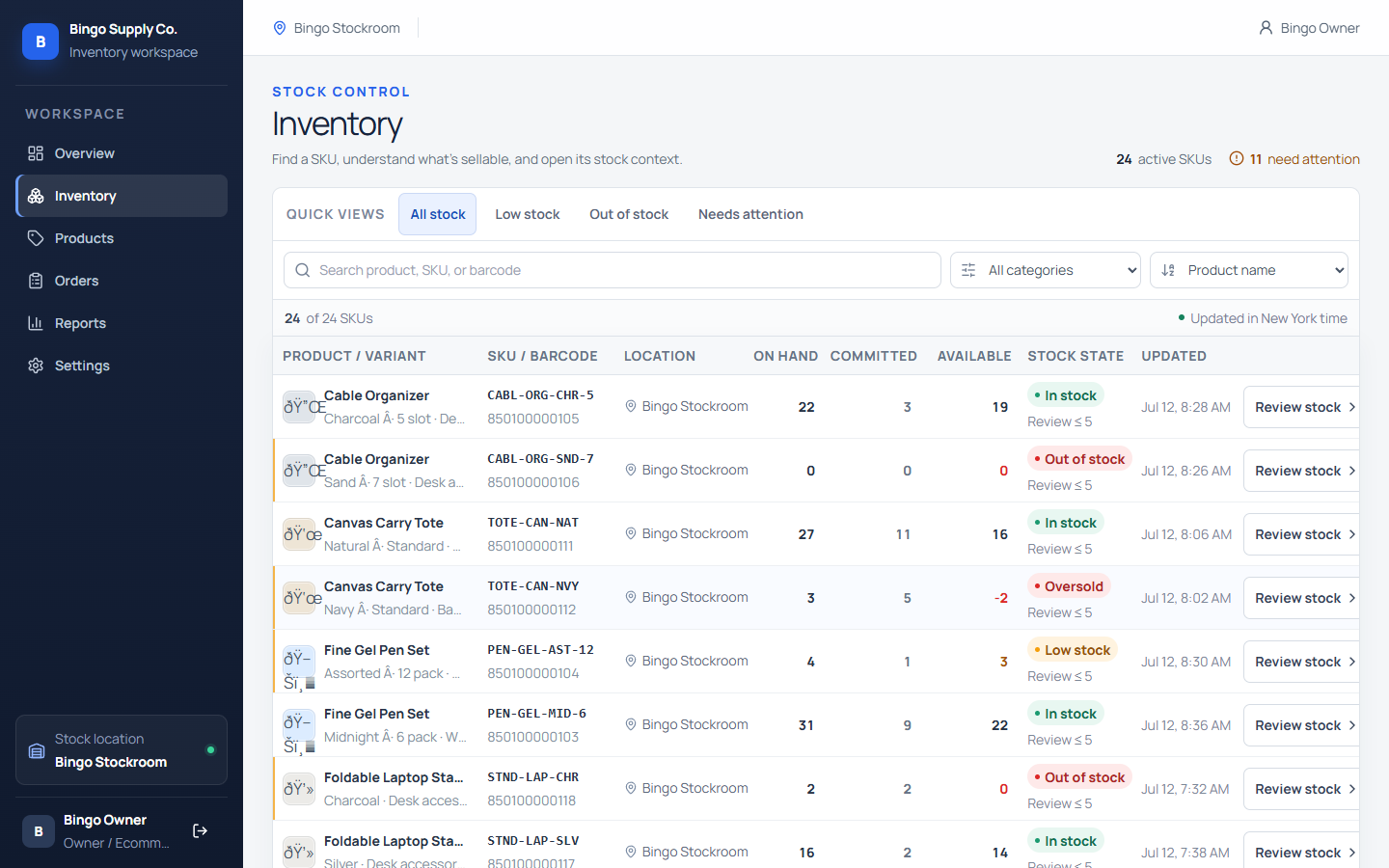 Live
LiveBingo Supply Co.
A focused build with honest oversold modeling (available goes negative when committed exceeds on-hand), the reserve → ship → cancel commitment cycle written as paired stock movements, and server-enforced owner-only settings.
Open live demo →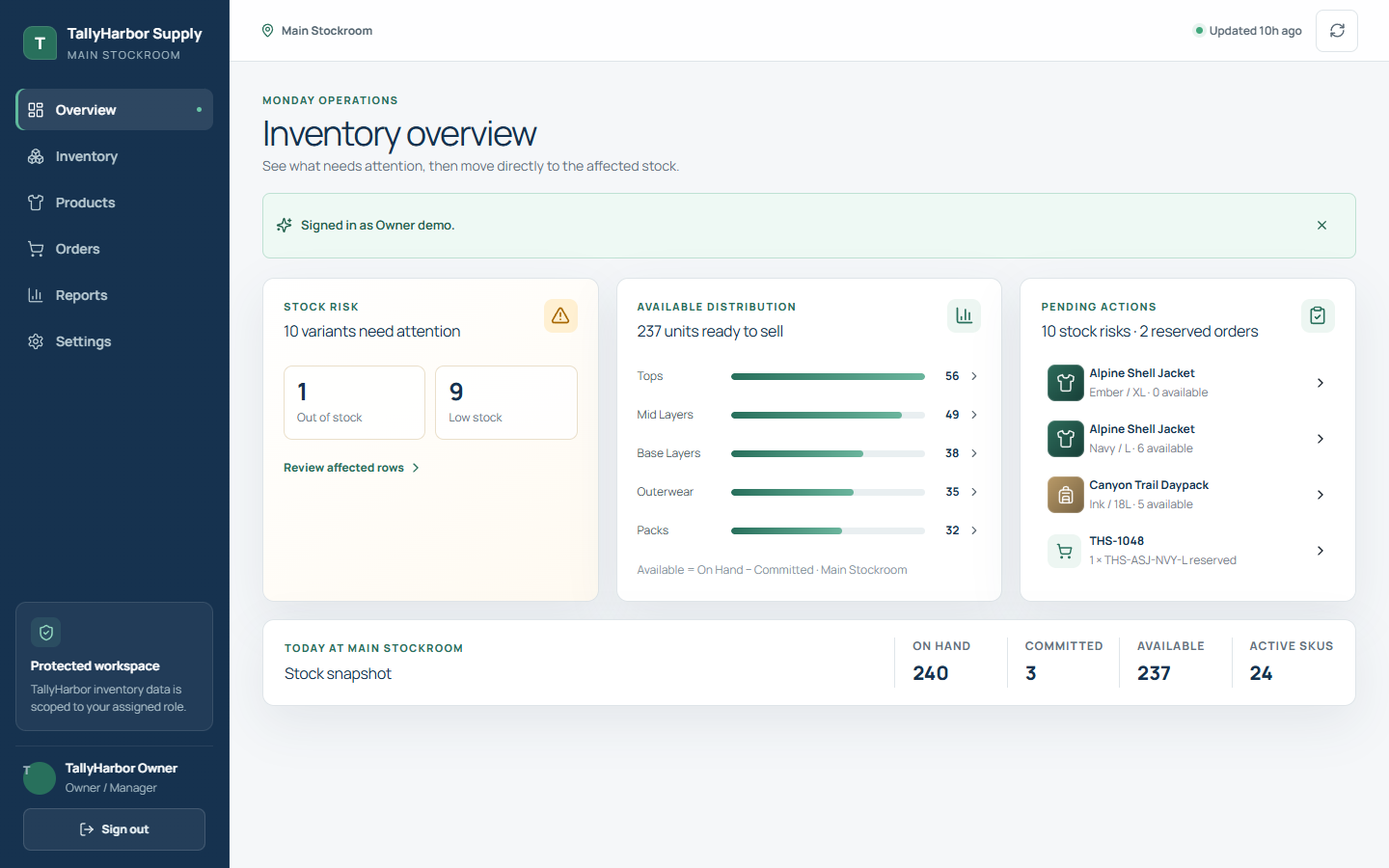 Live
LiveTallyHarbor Supply
The deepest order-commitment cycle of the basic builds — reserve, ship, and cancel with live adjustment previews, reasoned low-stock thresholds, and real CSV exports, behind credentialed owner/operator login.
Open live demo →