Job Board Planner
Turn 'build me a job board' into a scoped, evidence-backed CLAUDE.md spec — without ATS bloat, and without one employer seeing another's applicants.
The problem this kills
"Build me a job board" is one of the most scope-exploding prompts you can hand a coding agent. Within minutes it has invented an ATS pipeline, a Stripe subscriptions system, a resume-parsing engine, backfill scrapers, and a multi-tenant SaaS architecture — none of which you asked for, and all of which will eat your budget before a single real employer can post a job.
The opposite failure is equally common: agents ship a wafer-thin public list with fake seed data, no employer isolation, no job expiry handling, and a resume upload that stores nothing. Everything looks done until a second employer logs in and sees the first employer's applicants.
We stopped guessing about that one. We handed this planner to four coding models and audited what each shipped, and the failure above is exactly what separated them. Two builds enforce the boundary in both directions — an employer opens its own applicant's resume and is refused on a rival's, proved with a control so an empty result means real filtering rather than an accident. One shipped with no authorization at all: candidate contact details and a full database export were open to anyone who asked. All four are live below, and the scores are on the board.
Why your agent can't fake this
This planner is built from a research pass across 40 unique job-board products and vendors, drawn from 62 reviewed source pages — open-source starters, live SaaS platforms, CodeCanyon-style marketplace scripts, and one authenticated vendor demo. Every scope decision is anchored to what those products actually ship.
That corpus is what produces the specifics: resume upload is never scoped without private storage, signed access and a retention posture; the employer posting flow carries a real draft / submitted / published / expired / closed state machine; SEO scope requires that closed and expired jobs agree with your sitemap and JobPosting schema; and ATS pipeline depth is held back as a named branch rather than a Basic default, because it is a recruiting-tool concern rather than a job-board one.
Your agent cannot reproduce that shape of decision — "resume upload requires private storage, signed access and a retention posture, and here is the boundary where ATS depth stops" — without redoing the scrape. That evidence is what the planner encodes into every scope decision, default and guard rail.
We publish the corpus we reviewed, and we do not publish per-feature frequency percentages for this vertical yet: the normalized one-vote-per-product matrix across all 40 is still being built, and we would rather show you the denominator than a number we cannot stand behind.
What you actually get
A structured questionnaire that runs before your agent writes a single line of code. The planner asks your business model first — one-off niche board, employer-paid business, aggregator, association career center, ATS/recruiting platform, or multi-board SaaS — because the answer determines which of fourteen feature branches belongs in your First Delivery and which must be explicitly deferred.
After discovery, the planner generates one complete CLAUDE.md or AGENTS.md build spec containing: locked decisions, a forbidden-family scan that prevents deferred modules from leaking into active build steps, role and permission tables, a data model, a screen map with UI quality rules, server-side RBAC requirements, resume upload security gates, job lifecycle and SEO hygiene rules, an include/defer/skip ledger, and a nine-step build sequence with "do not continue until" acceptance gates at every step.
Every major recommendation cites a real evidence anchor — INV-, P, UI-, TECH-, PRICE-*, or frequency data — so you can audit what drove each decision.
Coverage
Phase 0 — First Delivery depth. Basic (7-9 build steps), Moderate (10-15 steps), or Advanced. Basic defaults to a single job board with public job search, employer posting, candidate application, resume upload with private storage, admin moderation, basic reports, and status-aware SEO.
Block 1 — Business model and board type. One-off niche board, internal careers portal, employer-paid board, association career center, aggregator, ATS platform, marketplace-script clone, or multi-board SaaS. Board size and who can post jobs.
Block 2 — Users and must-love workflow. Which roles exist; which one must love First Delivery most. Covers admin, employer/recruiter, candidate/job seeker, hiring manager, finance admin, and content moderator.
Block 3 — Core job-board loop. Public job list with search and filters, job detail pages, candidate apply flow, resume upload, candidate accounts, employer posting dashboard, employer applicant review, admin moderation queue, JobPosting structured data and sitemap hygiene, and basic reports and exports.
Block 4 — Branch selection. Paid listings, featured jobs, employer subscriptions, job alerts, saved jobs, company profile pages, backfill and aggregation, ATS pipeline, interviews and scorecards, AI matching, API and SSO integrations, multi-board SaaS, SMS notifications, and assessments. Each branch is gated — it cannot leak into Basic unless the buyer explicitly selects it.
Block 5 — Policies and local blockers. Country, currency, and language. Candidate model: guest apply, accounts, or both. Duplicate application policy. Job lifecycle and moderation approval policy. Resume and file handling. Existing data to import. Privacy, consent, and retention rules.
Block 6 — Stack, hosting, UI, and handover. Next.js, Laravel, Django, or no preference. Cloud, VPS, or self-hosted. Mobile-first candidate surface or desktop-first employer workbench. Whether the agent continues to Step 1 automatically after writing the spec.
The reviewed corpus.
Per-feature frequency is not published for this market yet. The normalized one-vote-per-product matrix across all 40 products is still being built, and we would rather show the corpus we reviewed than a percentage we cannot stand behind.
Real apps this planner built.
Each one is live — sign in and try it. Compare all 4, with their scores →
 Live
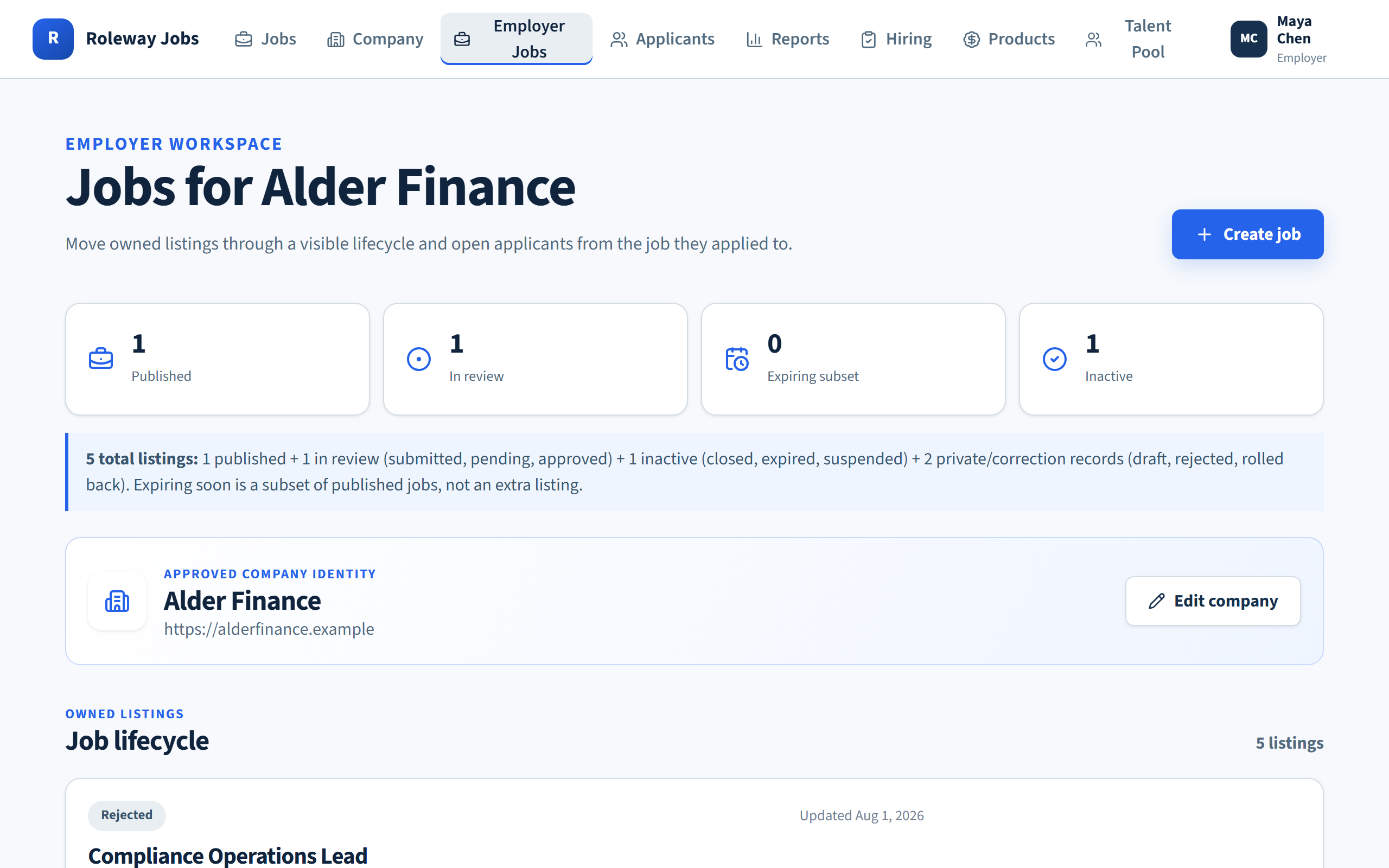
LiveRoleway Jobs
The top build. Cross-company isolation is enforced two ways and proven with a control: a recruiter sees their own company's applicants and gets a hard refusal on another's, in both directions. Every write is origin-checked, sign-in is rate-limited, and passwords use scrypt with constant-time comparison. Sign in as employer@roleway.local / RolewayLocal!2026.
Open live demo →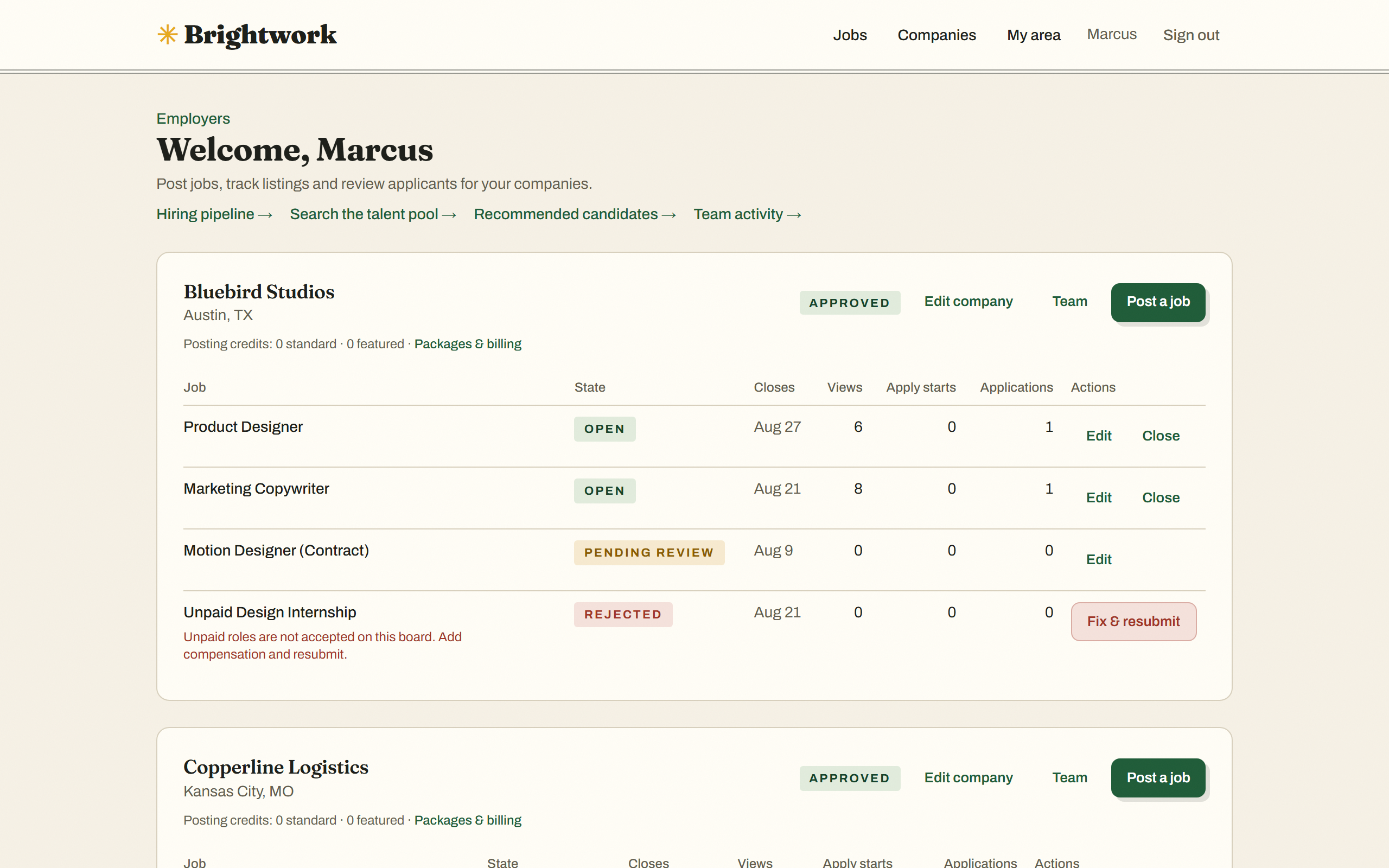 Live
LiveBrightwork
The clearest proof of tenancy in the group — it seeds several real employers, so you can watch one company get its own applicant's resume and a flat refusal on a rival's. External sign-on refuses to mint an administrator session, and talent-pool access dies the moment a candidate withdraws consent. Sign in as employer@brightwork.demo / brightwork-demo.
Open live demo →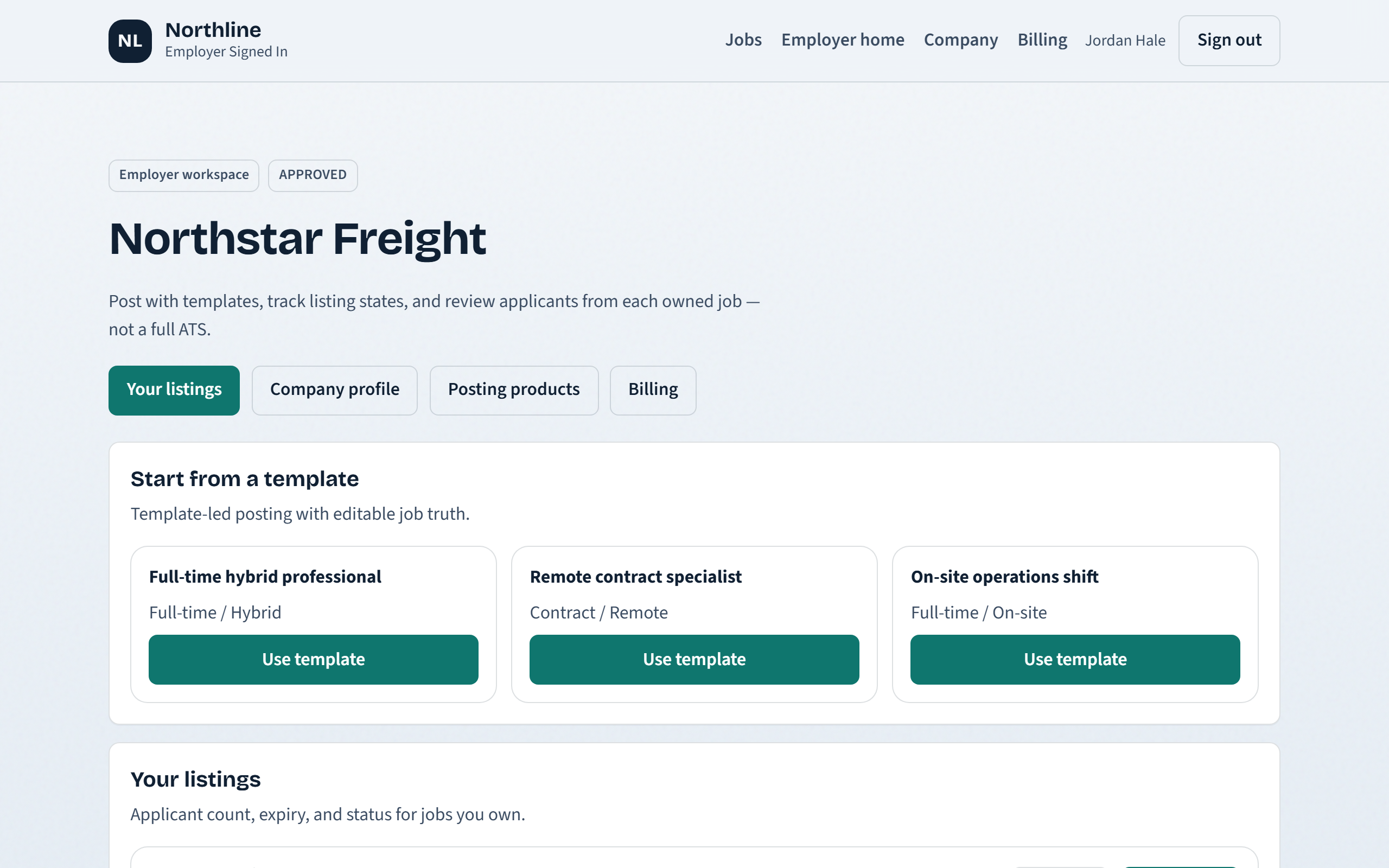 Live
LiveNorthline
A complete marketplace — employer approval queues, moderation, paid placement and a candidate portal, with applicant isolation verified against a control. Its abuse-report path originally let any visitor pull a paid listing off the board; that has since been fixed. Sign in as employer@northline.demo / northline-demo.
Open live demo →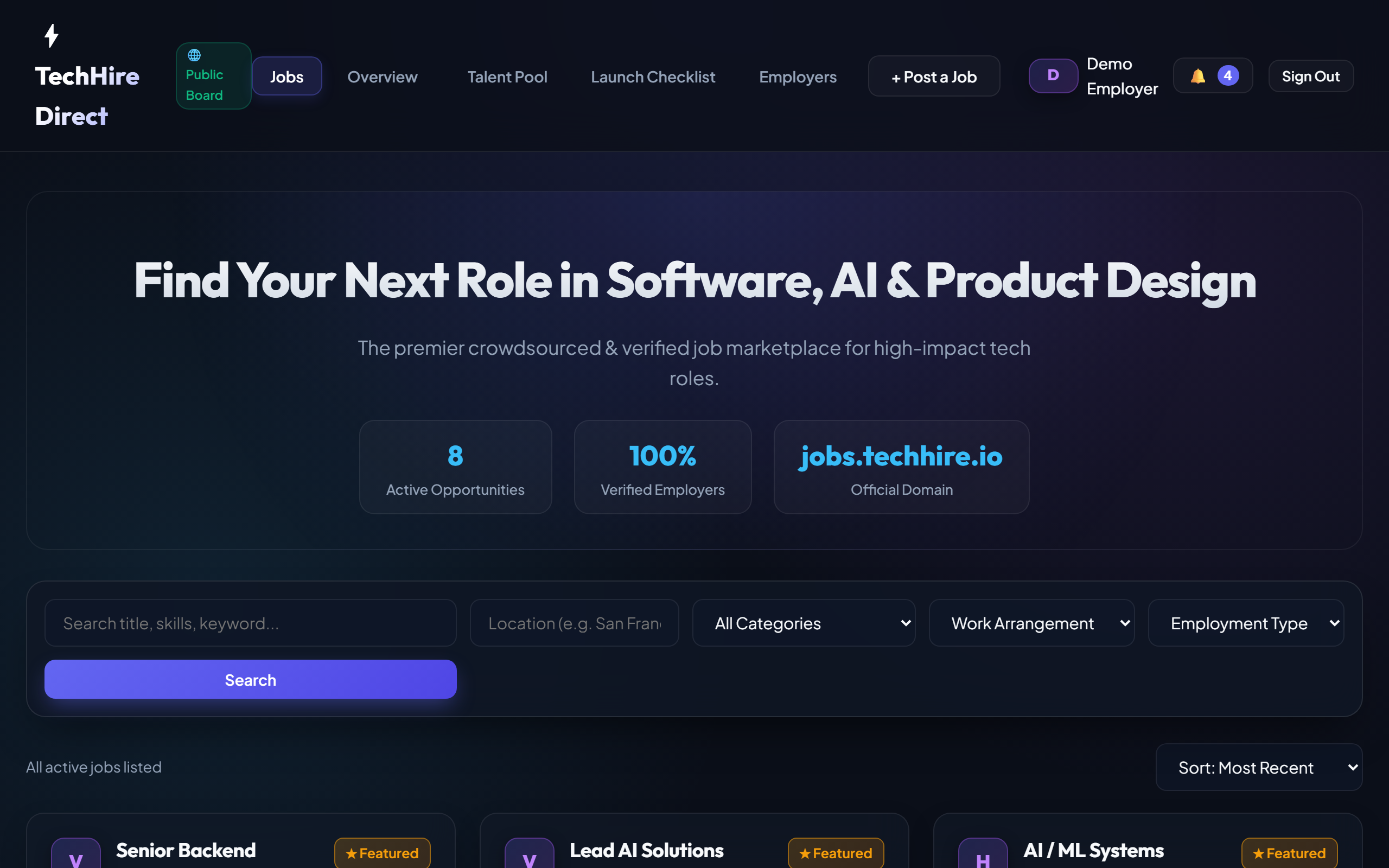 Live
LiveTechHire Direct
A fast-tier model's take — a working board with search, employer tools and admin reporting. It originally shipped with no authentication or authorization at all; password sign-in, per-record scoping and a regression gate were added afterwards and independently re-verified. Sign in as employer@techhire.io / employer123.
Open live demo →