Retail POS Planner
Research-backed planner that scopes a real point-of-sale build from 60 counted retail POS products — a cashier-first counter with durable receipts, reversible money, and controls that actually hold.
The problem this kills
Most vibe-coded POS builds collapse at the counter. The agent delivers something that looks like a till, then fails the moment money moves: checkout that never writes a durable numbered receipt, stock that doesn't decrement when you sell, a "void" button that erases a sale from the very report that exists to catch theft, and returns that hand cash back but never reverse the stock, the loyalty points, or the store credit the sale created. One person can ring a sale, pocket the cash, void it under their own name, and leave a drawer that balances to zero.
These are not polish bugs. They are the reason a retail POS is the hardest of the small-business apps to get right — the failure surface is the money path, and a generic agent has no grounded model of the controls a real till enforces. It exposes background inventory, policy and admin menus before the counter even works, treats a refund as a status dropdown, and calls three hardcoded numbers a "Z-report."
Why your agent cannot fake this
This planner is grounded in a frequency audit of a fixed 60-product retail-POS cohort, drawn from 127 inspected source pages across live products (Lightspeed, Hike, Shopify POS, Square, ERPNext, Dynamics, RMH, and more), marketplace scripts, and open-source codebases. Every capability carries a coverage anchor — cashier sell/checkout 60/60, stock visibility 58/60, source-backed reporting 51/60, register/cash close 18/60 — tied to a machine-readable product-feature matrix, not to the model's guesses.
Your own agent cannot reproduce "register close appears in 18 of 60 inspected sources, and lifecycle risk overrides that low marketing frequency" without redoing the scrape. More importantly, it does not know the control rules the research encodes: that a void must reverse every ledger the sale wrote and still appear in the reports; that a refund reverses stock, loyalty and stored value inside one transaction or not at all; that a material register variance and an over-threshold discount need a second signature from someone other than the person acting. Those rules are in this package because a real till lives and dies by them — and they are exactly where generic builds fail.
Proven in a live build-off
This planner has been dogfooded end-to-end: three working point-of-sale systems were built from it by three coding models — GPT-5.6 Sol, Claude Opus 4.8 and Grok 4.5. All three run as live demos you can ring a sale through from this page, and the full audited ranking is published as a PlanSmith benchmark. The planner is the product; the apps are the proof.
What you actually get
A cashier-first planner that locks the counter experience before anything else. It walks your agent through depth and store-model decisions, then holds the build to money-path gates:
- Depth tiers, honestly bounded. Basic is a shoppable counter — 8 features / 24 functions / 5 workflows. Moderate is an owner-operated store — 14–18 features / up to 54 functions. Advanced reaches 19–22 features / up to 66 functions with register control, purchasing, counts, staff approvals, transfers, offline and stored value.
- The must-love role is the cashier. Complete a correct sale fast without losing the queue — Sell, held sales, tender, receipt, lookup and permitted returns lead the product; governance, policy and audit menus are forbidden from primary navigation.
- Money integrity as hard gates. Durable numbered receipts, stock that reconciles to every movement, refunds that reverse stock + loyalty + stored value together, register open/close with counted variance, and second-signature approval on the surfaces that move money — each proven against its own lifecycle, not a completion checkbox.
- Store model as an explicit branch. Single store, multi-location with transfers, and omnichannel/ecommerce are separate decisions — never silently bolted into a core till.
The planner emits a hot CLAUDE.md or AGENTS.md plus split spec files, with a custody gate that stops the agent from scaffolding before the spec is written and locked.
The frequency-ranked ledger.
Real apps this planner built.
Each one is live — sign in and try it. Compare all 3, with their scores →
LiveSaffron Till
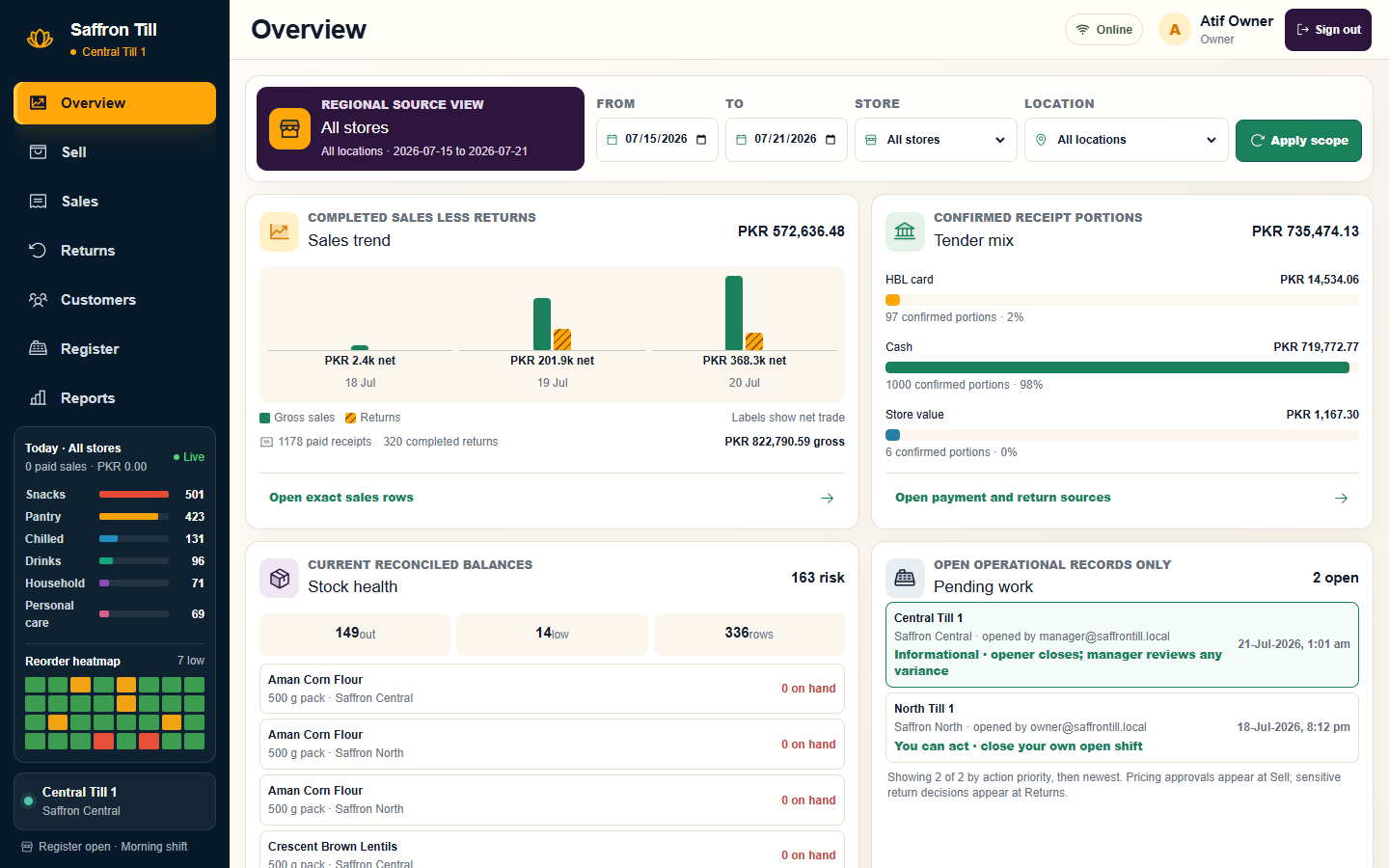
The top build — the cleanest money path on the board. Loyalty reversal on a return is proportional and idempotent in both directions, verified against real data; refunds reverse stored value too; and a second signature is required from someone other than the person acting. A neighbourhood grocery counter in PKR. Click Demo Owner on the sign-in.
Open live demo →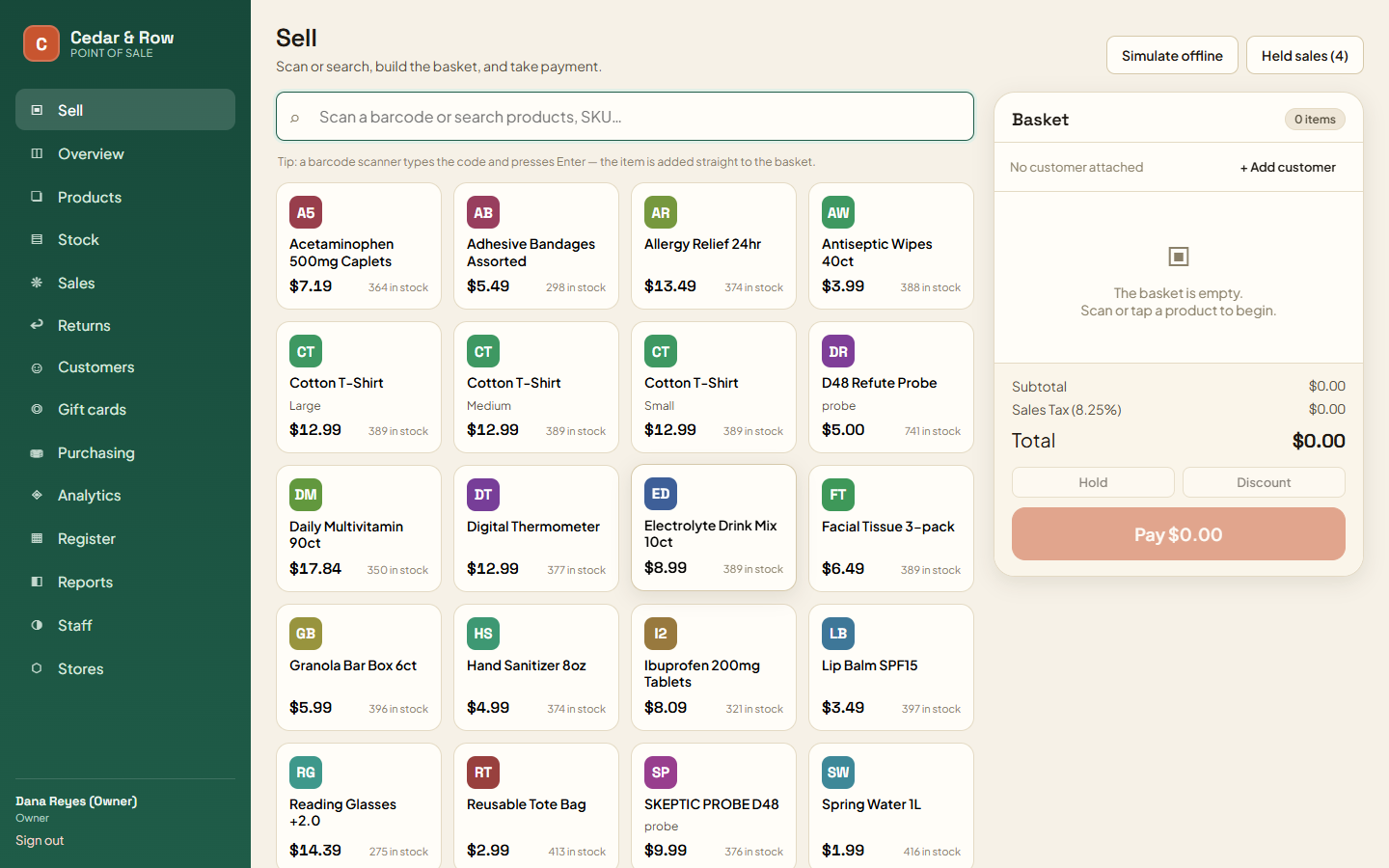 Live
LiveCedar & Row
The most self-critical build — its own acceptance panel found a dangerous 'void sale' loop, so the build withdrew the void endpoint outright and routes every correction through Returns, which reverses money, stock and points together and records who approved it. You cannot countersign your own refund. Tap a demo account to fill, then Sign in.
Open live demo →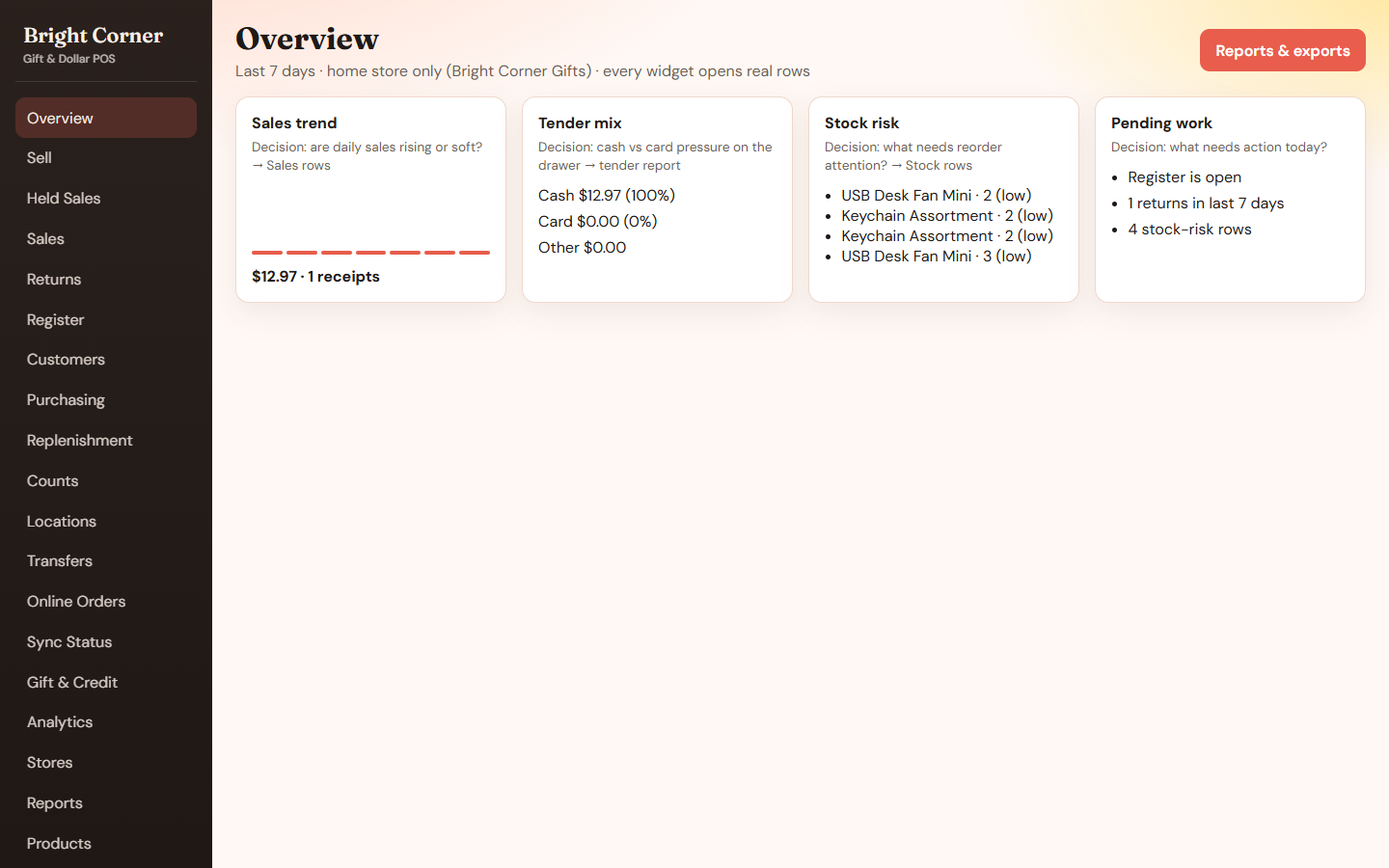 Live
LiveBright Corner
A complete gift & dollar store — twenty operator screens, working loyalty clawback and a real segregation-of-duties gate, with the honest 'card blocked, no live provider' notice shown right in the pay dialog. Sign in as owner@brightcorner.local / pos12345 (all demo passwords are on the login screen).
Open live demo →What to know before you build.
- We had three AI models build the same point-of-sale system. The sale was easy. The refund wasn't.
- POS system in Excel: a sales and cash-drawer template that works, where it breaks, and what replaces it
- POS system for small business: what actually matters, counted across 60 real products
- Cash register vs POS system: the honest line between them
- POS system cost: the line that isn't the software
- Free POS software: what you're actually paying, and where it stops