Build vs buy: retail inventory management in 2026
If you run a shop and you're deciding whether to buy a retail inventory management system or build your own, the internet has already lied to you twice. Every SaaS vendor says buy theirs. Every developer says build it. Neither is advice — they're both selling. We've spent a lot of time inside these systems: reading the market, counting features across 120 real retail products, and watching what happens when a stock app is built badly. Here's the honest version, including the parts nobody puts in the pricing page.
Start with the real question
"Build vs buy" hides the decision that actually matters: how far does the way you move stock diverge from what a standard product assumes? A single-store shop with normal SKUs, normal suppliers, and normal counts should almost never build. A store with a fulfillment quirk the product can't express, or margins it needs to own, or a workflow the SaaS charges extra to unlock, will fight an off-the-shelf tool forever. The question isn't build or buy — it's how much friction can you tolerate, and what does removing it cost.
When buying off-the-shelf is the right call
A ready-made platform — Square, Lightspeed, Loyverse, Zoho Inventory, and the rest — is genuinely the better choice when most of these are true:
- You're a single store (or a couple) with fairly standard retail needs and no appetite to maintain software.
- You need barcode scanning, low-stock alerts, and basic reordering running this week, not next quarter.
- Your catalog, counts, and purchase-order flow fit what the product already does out of the box.
- You want the POS, payments, and stock to be one integrated thing you don't have to wire together.
- You'd rather pay a predictable monthly fee than carry a build-and-maintain cost.
If that's you, buy, and don't look back. These tools are excellent at standard retail, and a stock system you can't maintain is far worse than a subscription you can. The graveyard of retail software is full of bespoke systems that worked right up until the one person who understood them moved on.
When renting quietly fails you
The off-the-shelf path stops being cheap the moment your reality diverges from the product's assumptions — and it has one failure mode that pure SaaS math ignores: you don't own the thing you depend on. Shopify's Stocky is the cautionary tale. Merchants ran their purchase orders, stock counts, and reorder points on it for years, and then it was sunset — leaving shops to migrate those exact workflows somewhere else, on someone else's timeline, not because their business changed but because the vendor's roadmap did. When you rent your inventory system, that risk is always on the table.
The other cracks show up more gradually:
- Your workflow doesn't fit. You bend the store around the software — running transfers as a side spreadsheet, faking pack-size conversions, tracking consignment by hand — instead of the software around the store. Every workaround is permanent friction.
- The report you need doesn't exist. So someone exports raw data and rebuilds sell-through or dead-stock by hand every week. You bought software and kept the manual work.
- Per-month, per-seat, per-location pricing compounds. A plan that's trivial for one store becomes a real annual line item across three, and per-register or per-user add-ons stack on top.
- The good features are behind the next tier. Multi-location stock, advanced reporting, and open API access are routinely the upsell — the "affordable" base plan isn't the plan you actually need.
- You don't own your data or your roadmap. You're renting both, and the day the vendor sunsets a feature — or the whole product — the migration is on their terms.
The honest build case
Building gets you the things renting can't: exact fit, data you own, no per-seat or per-location tax, and a system that can encode the thing that makes your store different. If inventory is your edge — a curated boutique with matrix variants, a shop with an unusual receiving or consignment flow, a small chain where per-location SaaS pricing is the number that stings — a build that fits is worth a lot.
The catch has always been cost. A real retail stock system is not a to-do list with a quantity column. Count the surface honestly and it's substantial: across the 120 retail products we studied, on-hand quantity by item and location showed up in 32 of them, a physical stocktake workflow in 23, purchase-order creation in 24, receiving against those POs in 18, and low-stock reordering in 17. That's before variants, transfers, valuation, or audit trails. Traditionally, commissioning all of that for a single store was prohibitive — which is exactly why most independent retailers rented.
That math is what AI coding agents changed.
What agents changed — and what they didn't
An agent can now produce a working inventory app from a paragraph. The cost of typing the code has collapsed. But here's the part the hype skips: agents collapsed the typing cost, not the knowing cost. The scarce input was never the keystrokes. It's knowing what a retail stock system has to get right — and a vibe-coded inventory app fails in specific, repeatable ways. We've catalogued them:
- Stock numbers you can edit directly, with no movement ledger behind them. The single most common failure. On-hand should be derived from receipts, sales, counts, and adjustments — never a field you overwrite. Overwrite it and you've built a spreadsheet with extra steps and no way to answer "why is this wrong?"
- Stocktakes that are just a plain table. A real count is a session: scan, record, surface variance, review, then commit auditable adjustments. A grid you type numbers into loses the entire point.
- Purchase orders with no receiving state. A PO isn't a document; it's a lifecycle — draft, sent, partially received, closed. Skip receiving and stock never actually books in, so on-hand and reality drift apart from day one.
- Passive low-stock cards. A red badge that just sits there is decoration. Low stock should be a queue that hands off straight into creating a purchase order.
- Decorative dashboards. Charts that look impressive and drill into nothing. A retail dashboard's job is to route you to the source rows behind stock risk, count variance, and sell-through — not to be pretty.
- Add the quieter ones: transfers faked as plus/minus adjustments instead of a send-and-receive with variance, scan and label flows that only fire a toast, and QA seed data leaking into live operational queues.
Each of these looks finished in a demo and falls apart the first week a real store uses it. The agent will happily build any of them, because the agent doesn't know they're wrong. That knowledge is the product now — not the code.
The middle path
There's a third option that gets you the fit and ownership of building without the toy risk: an evidence-grounded spec plus your own agent. Instead of "build it with AI" as a hope, you hand the agent the decisions, data model, and build order that keep it out of every trap above.
If you're weighing this against quotes from a development firm, custom inventory management software breaks down what those quotes are actually priced on, the operational shapes that genuinely justify a bespoke build, and the eight questions that separate a supplier who has built stock systems before from one who hasn't.
That's what PlanSmith's retail inventory planner ($49) is — the 120-source research, encoded as a CLAUDE.md your coding agent reads before it writes a line. And we don't ask you to take that on faith. We gave the same planner to four different coding models and audited what each one built. Seven working retail stock systems came out — each with a real movement ledger, real receiving, real counts — and we ranked them publicly with live demos. The point isn't which model won. It's that the same knowledge produced a real system across four of them, which is the whole claim: the spec is what carries the quality, not the tool.
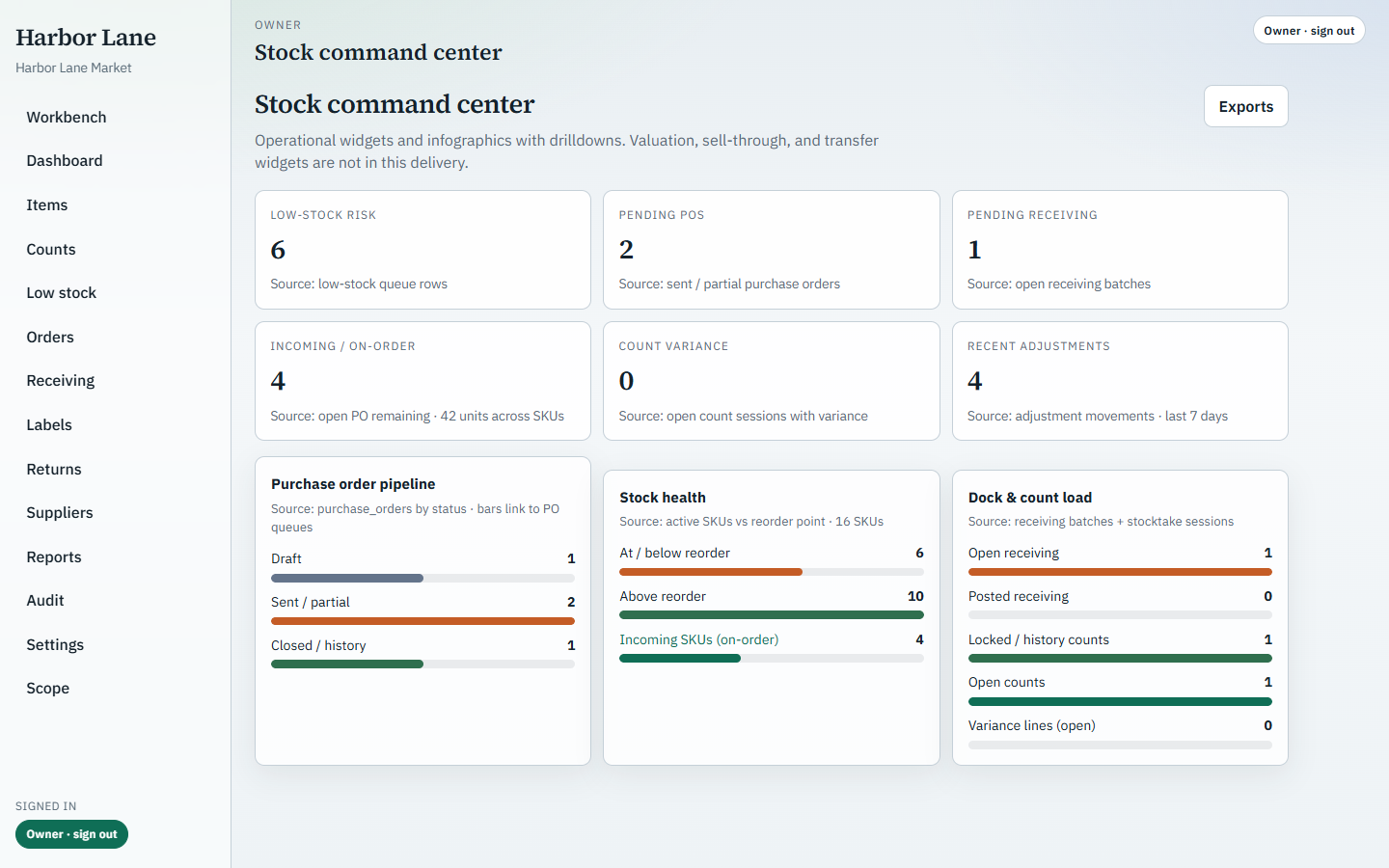 Harbor Lane Market — the same planner built by a different model (Grok 4.5): the full low-stock → PO → receiving loop, running as a live demo.
A simple decision framework
| Your situation | Lean |
|---|---|
| Single store, standard SKUs and counts, want zero maintenance | Buy |
| Need scanning, alerts, and reordering live this week, no dev capacity | Buy |
| Off-the-shelf nearly fits but for one or two gaps | Buy + live with the gaps (don't build for two features) |
| Vendor lock-in or a sunset risk genuinely scares you | Lean build — you own it |
| Your workflow, margins, or catalog don't fit any standard tool | Build — but build it right |
| Multi-location where per-store SaaS pricing compounds | Build — the economics favor it at scale |
| Want fit + ownership but no safe way to build it well | Planner + your agent (the middle path) |
The short version
Buy if you're a standard single store that wants zero maintenance — the Square/Lightspeed/Loyverse tier is genuinely good, and you should use it. Just go in knowing you're renting the workflow, and Stocky's sunset is what renting can cost. Build if inventory is your edge, if the economics compound across locations, or if you refuse to have your stock system depend on someone else's roadmap. But don't vibe-code a toy — an editable number with no ledger behind it is the worst of both worlds, because now you own the maintenance and it doesn't work. If you're going to build, build from what the market already proved out. The expensive mistake isn't buying or building. It's building it wrong, and paying for that twice.