Retail Inventory Management Planner
Turns 120 counted retail sources into an agent-executable store/stockroom spec — ledger-true stock, stocktakes, and a low-stock → PO → receiving loop, without POS or warehouse scope bleed.
The problem this kills
Retail inventory apps that come out of AI-assisted builds fail the same ways, over and over: the stock count is a directly editable number with no movement history, so nobody can explain why the shelf says 8 and the system says 14. The stocktake is a plain table instead of a count session with variance review and an auditable commit. Purchase orders exist but have no receiving state, so stock arrives and someone edits quantities by hand. Low-stock is a passive card instead of an action queue. Transfers are fake plus/minus adjustments. Scan and label flows only work as demos. Dashboard widgets are decorative. And QA junk data pollutes the queues a buyer sees on first load.
This planner exists to make those failures structurally impossible in the generated spec — every quantity-sensitive change flows through an immutable movement ledger with reason and actor, and every lifecycle (count, order, receive, transfer, return) has real states, not shortcuts.
Why your agent cannot fake this
The planner is distilled from a counted research pass over 120 retail-only source rows — Shopify Stocky (whose sunset is driving live migration demand), Square, Lightspeed, Hike, Loyverse, RetailEdge, KORONA, Erply, Heartland, and Epos Now, alongside open-source systems, marketplace scripts, and practitioner pain threads — plus 45 UI/workflow reference rows covering the screens themselves.
That pass produced 34 counted feature rows: 27 core product families, 3 branch families, 3 boundary decisions, and 1 data-hygiene rule, each tagged with how many sources directly evidence it. On-hand stock tracking by item and location is evidenced in 32 of the 120 rows; the item/SKU master and the full purchase-order lifecycle in 24 each; physical stocktake in 23; reports and exports in 21; receiving against POs in 18; the low-stock reorder queue in 17; store-to-store transfers in 15; barcode label generation and the drill-down stock dashboard in 14 each; the movement ledger itself in 12. The counts are directional research evidence, not product promises — and they are exactly the kind of grounding your own coding agent cannot reproduce without redoing the research.
Each row carries a delivery-tier default (Core Basic, Core Moderate, Core Advanced, Branch, or Boundary), so the generated spec proposes the workflows retail products actually ship before the ones they rarely do.
Proven in a live build-off
This planner has been dogfooded end-to-end: eight working retail inventory apps were built from it by four coding models — GPT-5.5 across four build lanes, Composer 2.5, Gemini 3.1 Pro, and Grok 4.5 across two lanes. All eight run as live demos you can log into from this page, and the full audited ranking is published as a PlanSmith benchmark. The planner is the product; the apps are the proof.
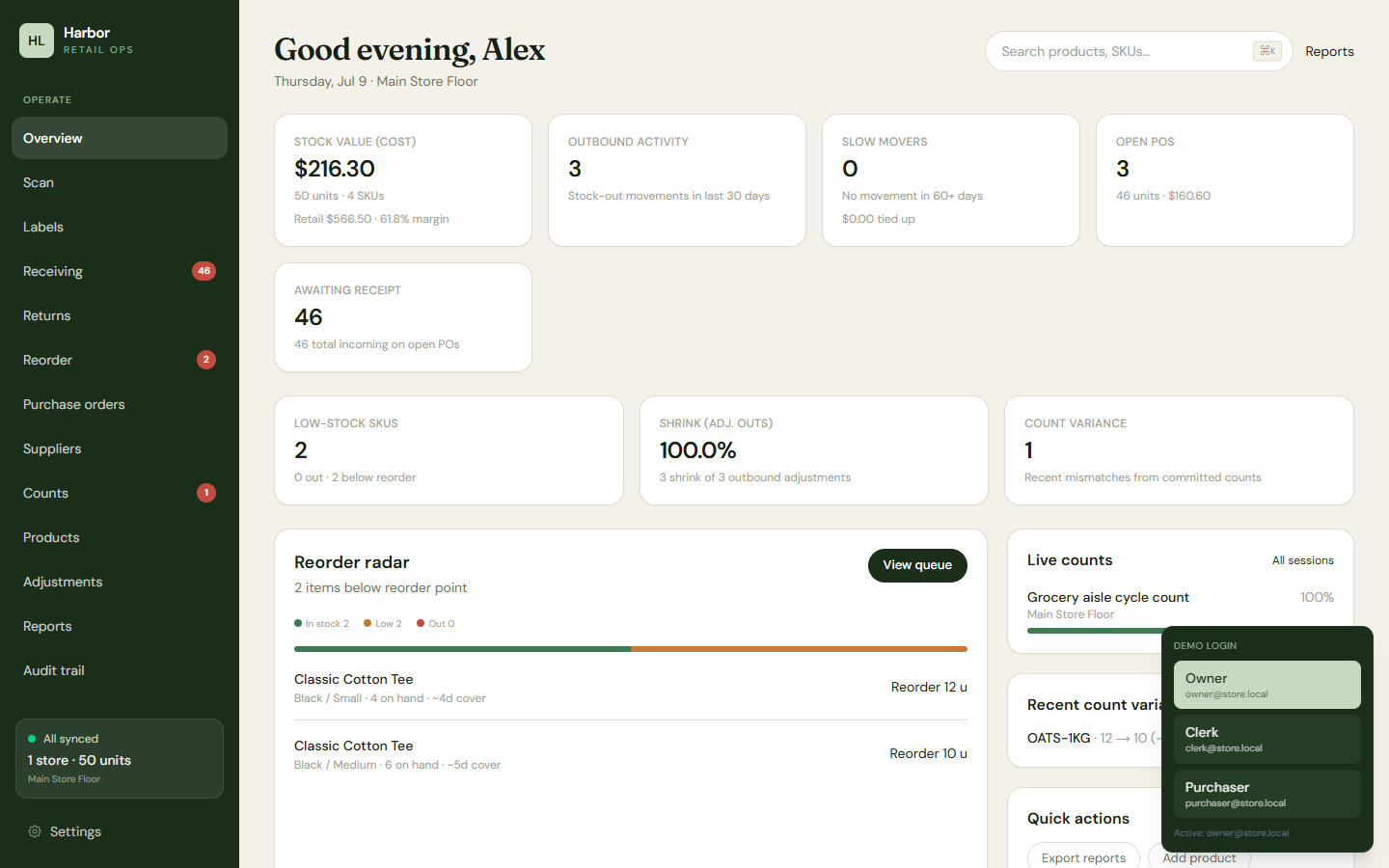 Harbor Lane General Store — ranked Best Overall in the build-off. Log into it live from the demos below.
What you actually get
A structured interview that forces the retail-shaped decisions before any code is written: store and location model, roles (owner/admin, stock clerk, purchaser, cashier), item/SKU master with categories and units, variant/matrix handling for size-color retail, opening stock and CSV import, the movement-ledger rule, adjustment reasons including damage and shrinkage, full and cycle count workflows, the low-stock → purchase order → receiving loop, barcode label and scan levels, transfers, vendor returns, valuation and velocity analytics, exports, and UI priority.
After discovery, a forbidden-family scan keeps adjacent scope out unless you explicitly select it: POS checkout, ecommerce sync, accounting ledgers, and warehouse operations (bins, pick/pack, putaway) are boundary families — they belong to their own planners, and they do not leak into a retail stock build.
The output is one complete, tool-aware build spec — CLAUDE.md for Claude Code or AGENTS.md for ChatGPT Codex — with build steps that name the tables they touch, the screens they produce, seed data, and a hard acceptance gate before the next step begins.
Coverage
Basic: single store, owner/admin and stock clerk roles, item/SKU master with search and filters, opening stock with preview-commit import, the immutable movement ledger, manual stock in/out/adjustment with reasons, a low-stock action queue, full stocktake with variance commit, a stock dashboard with drill-downs, reports and exports, and an audit trail.
Moderate adds: variants and matrix products, item photos and merchandising metadata, supplier directory, the purchase-order lifecycle, receiving against POs and ad-hoc, cycle counts, barcode label printing, scan-to-search and scan-to-count, and damage/shrink reason codes.
Advanced covers: store-to-store transfers with in-transit visibility, vendor returns, inventory valuation and margins, sell-through and dead-stock analytics, and pack-size ordering as an explicit branch.
Every branch is gated behind an explicit buyer selection. POS, ecommerce, and warehouse operations stay out — by design.
The frequency-ranked ledger.
Real apps this planner built.
Each one is live — sign in and try it. Compare all 8, with their scores →
 Live
LiveStockbay
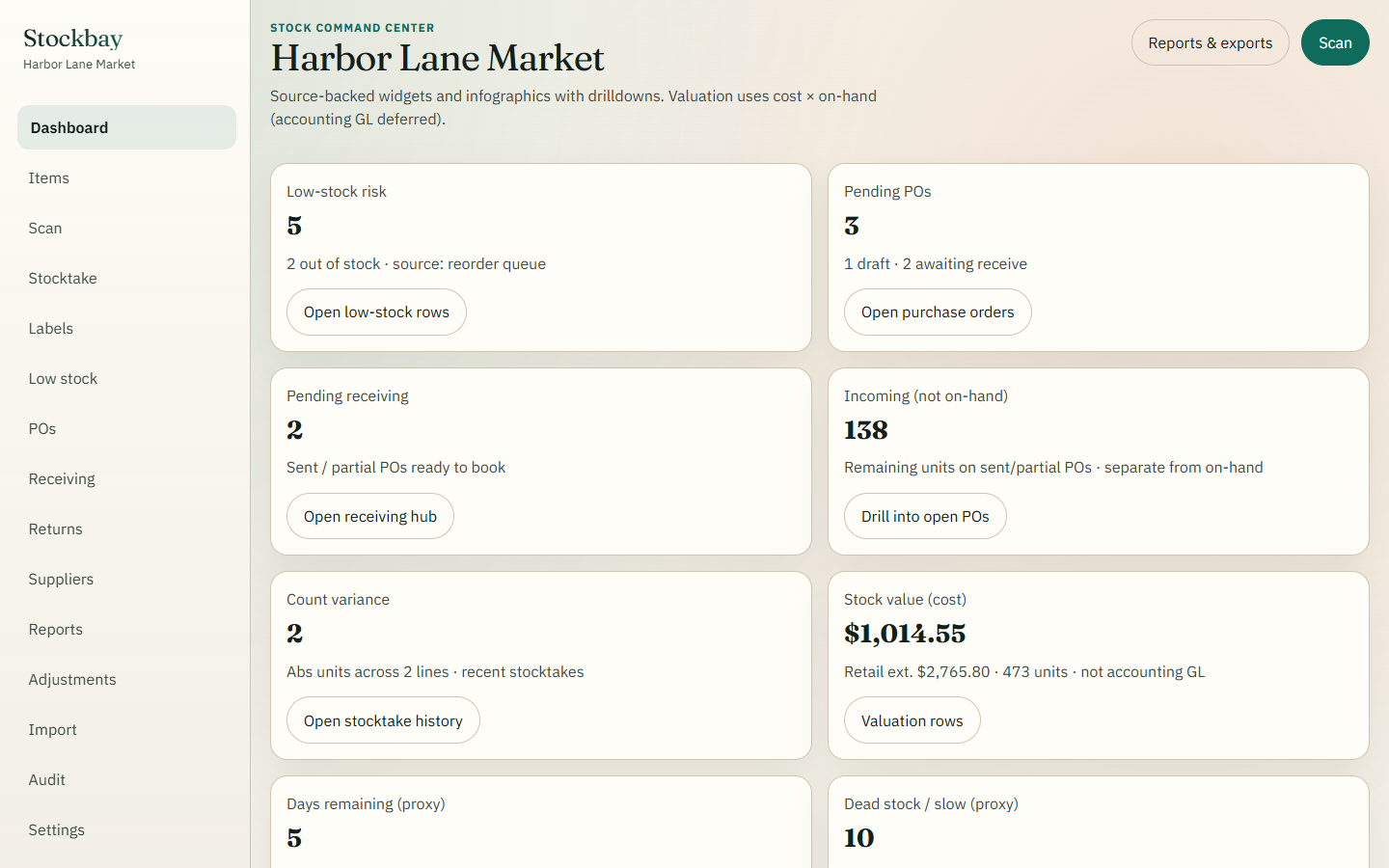
“Stockbay” — a movement-ledger purist: stock only ever changes through receiving, adjustments, counts, or returns, each writing before/after quantities with actor attribution. Fifteen surfaces — matrix items, scan, stocktakes, SVG label sheets, CSV opening-stock import, vendor returns, an audit trail — and eight CSV exports behind three role-aware logins.
Open live demo →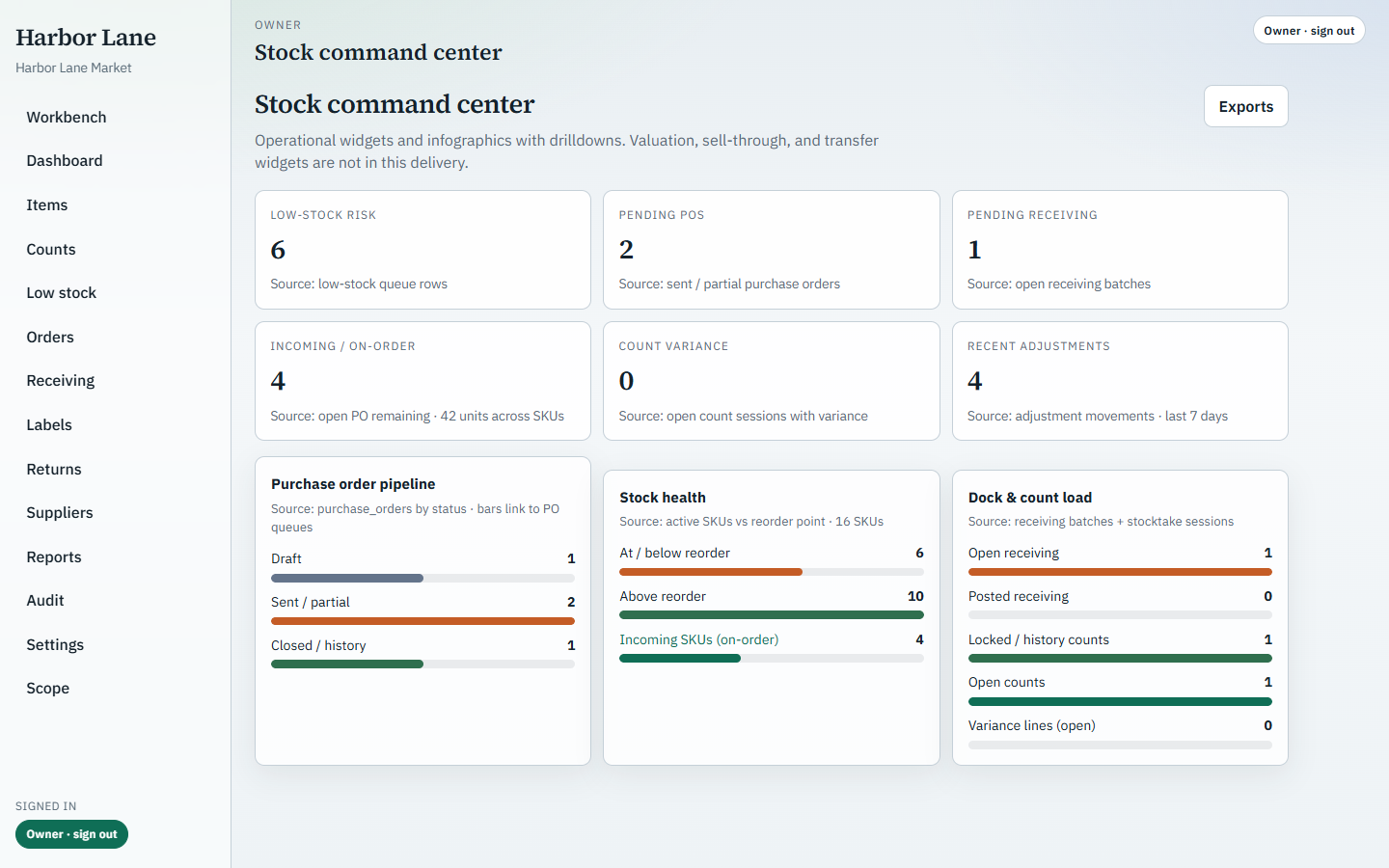 Live
LiveHarbor Lane Market
A single-store stock command center finished after the original audit: the full ops loop — purchase-order pipeline (draft → sent → partial), receiving against POs, counts with variance, vendor returns, labels, and reason-coded adjustments — behind real credentialed logins and a dashboard whose every widget names its data source.
Open live demo →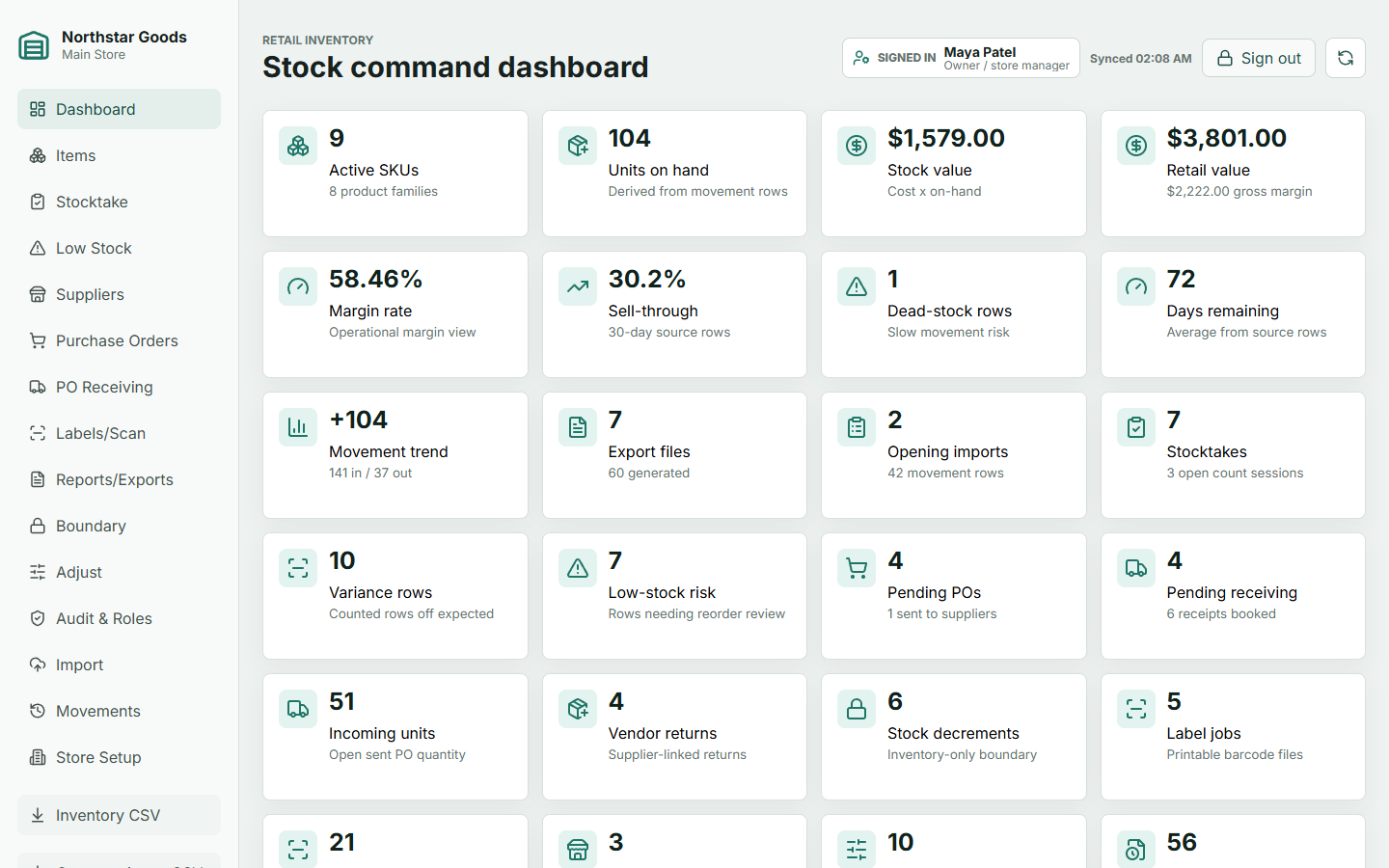 Live
LiveNorthstar Goods
“Retail Inventory Command” — every surface implemented with zero stubs: a drill-through KPI dashboard, items and variants, adjustments, stocktakes, low-stock rules, POs and receiving, vendor returns, labels and scan, and CSV exports, with four-role access control.
Open live demo →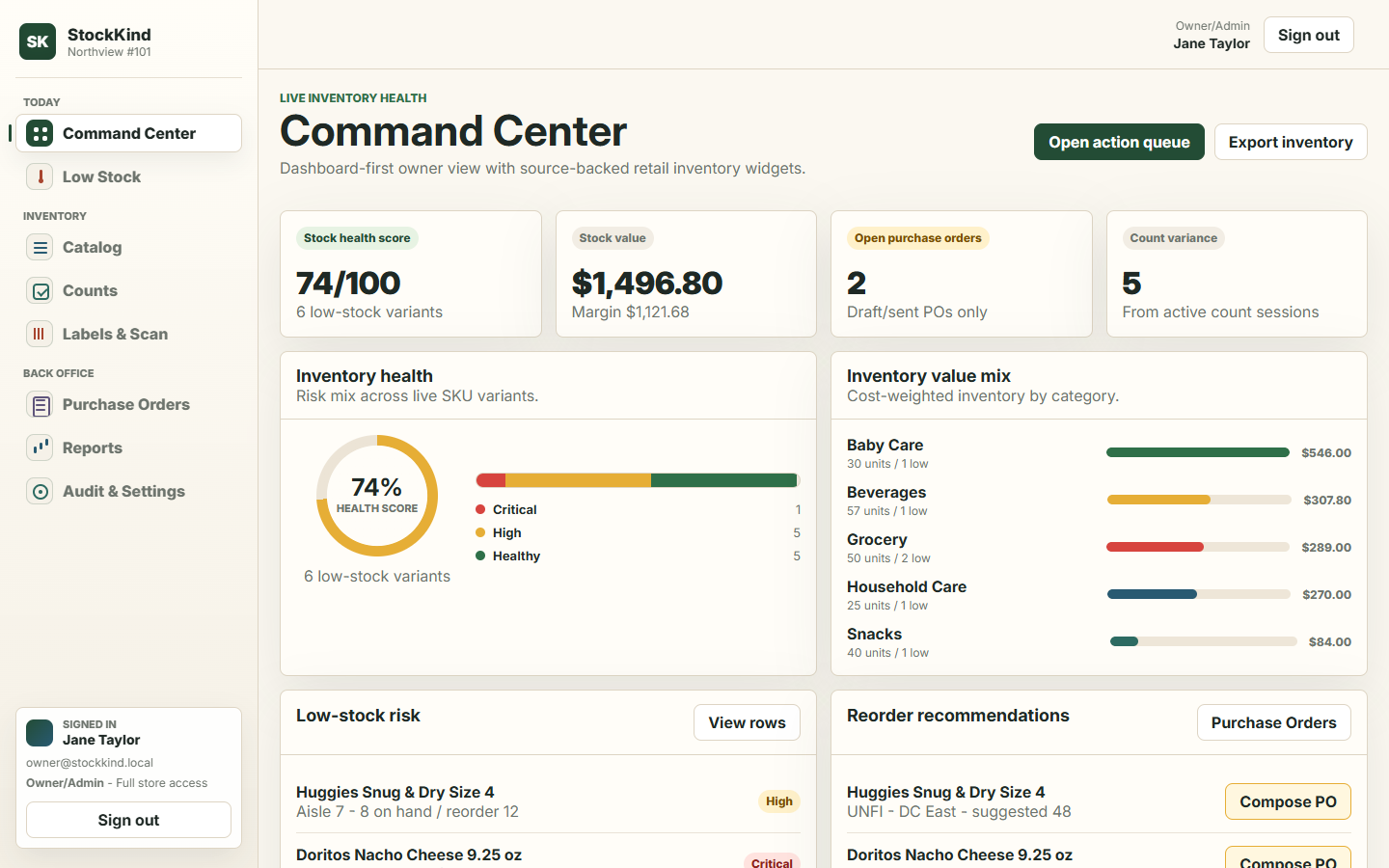 Live
LiveStockKind
“StockKind Inventory Command” — a zero-dependency build with the set's most data-visual dashboard: a stock-health score, category value mix, a risk-ranked reorder queue that composes POs, receiving with partial receipts, counts with variance commit, and seven CSV reports.
Open live demo →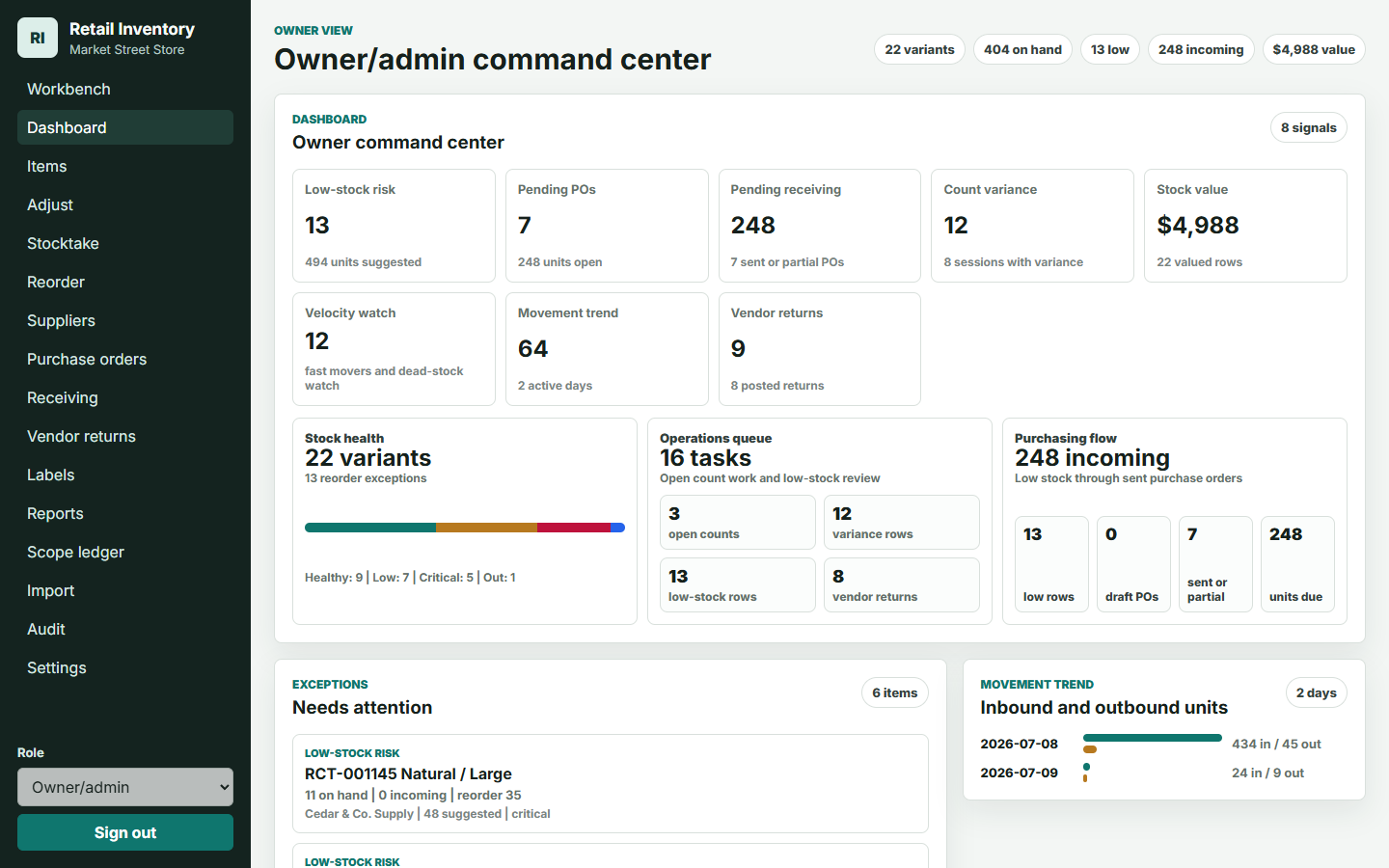 Live
LiveNorthline Outfitters
The broadest operations lifecycle of the set — receiving, vendor returns, adjustments with reason codes, full and cycle stocktakes, labels, scan workflows, CSV import, owner valuation, and eight exportable reports — over a real 22-table SQL schema with zero dependencies.
Open live demo →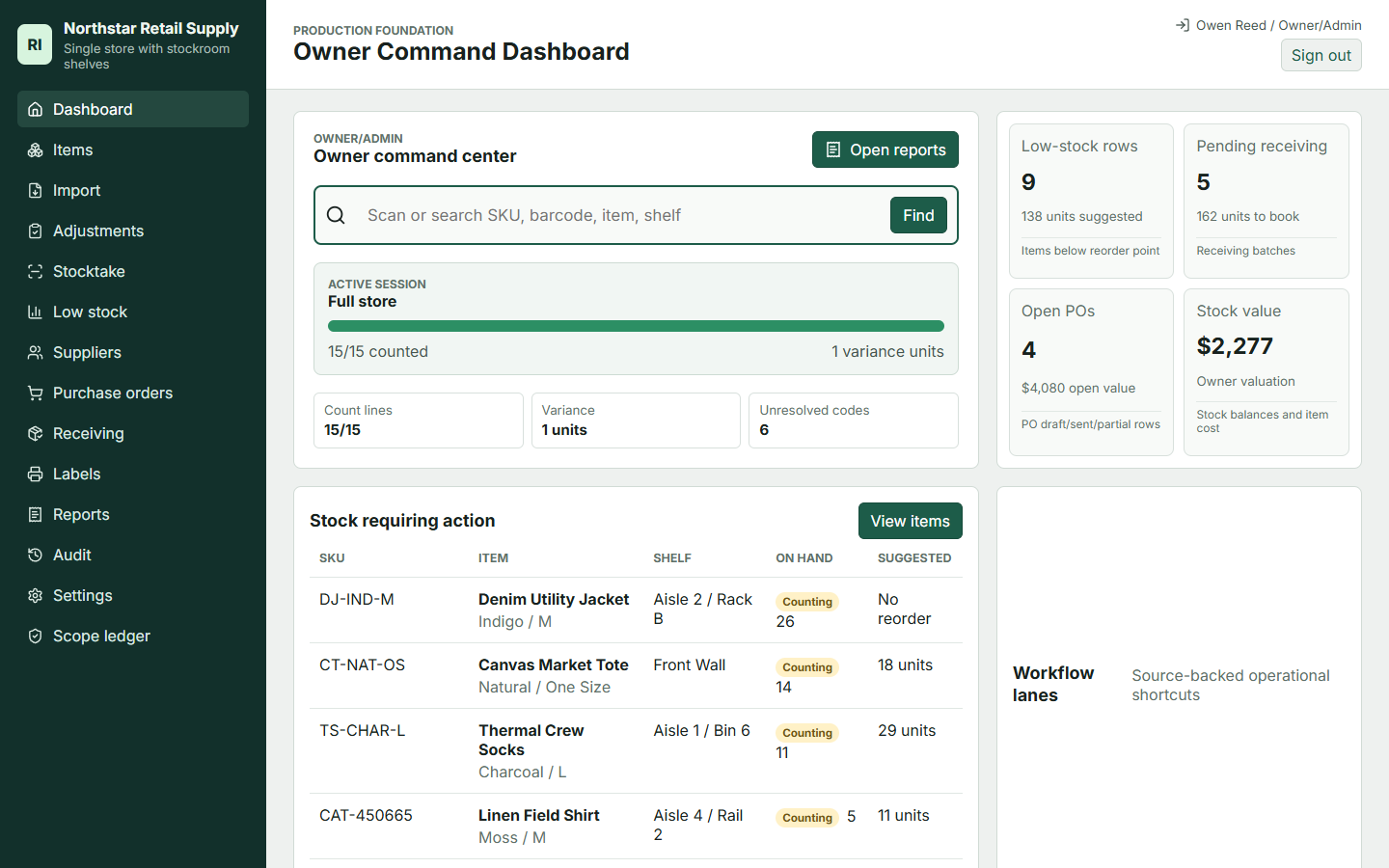 Live
LiveCommand Center
“Northstar Retail Supply” — a scan-first clerk workbench and owner command center: counts with live variance, receiving against POs and ad-hoc, unresolved-barcode reconciliation, labels, and role-gated valuation, over a rich cross-linked demo dataset.
Open live demo →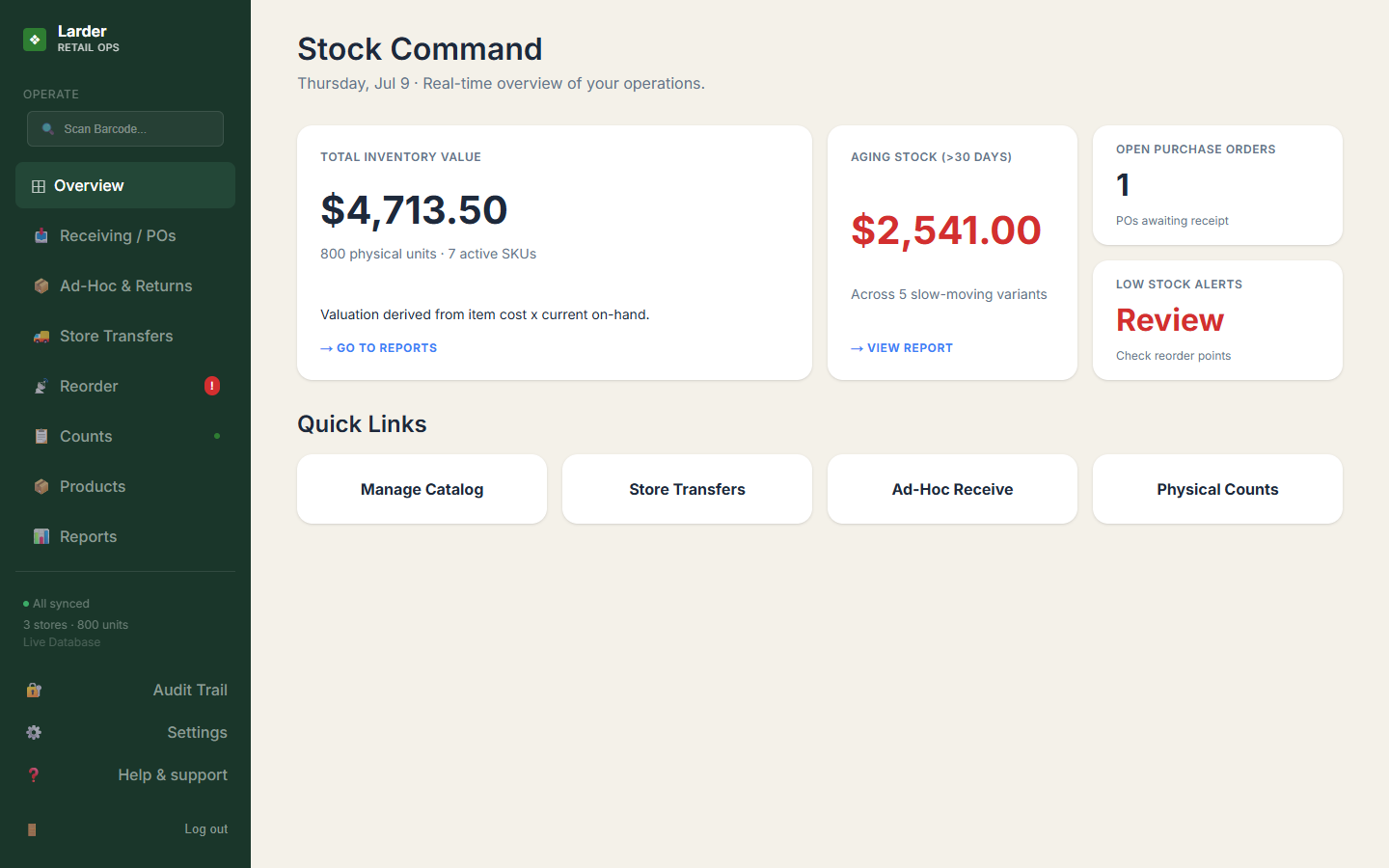
What to know before you build.
- Inventory management system database design: the schema, and the one column that ruins it
- Custom inventory management software: what you're actually paying for, and when it's the wrong answer
- Inventory management in Excel: a working template, where it breaks, and what comes next
- Free inventory management software: what 'free' actually costs, and how to choose
- What a retail inventory management system includes (feature checklist from 120 real sources)
- How to build a retail inventory management system: the practitioner's guide (2026)
- Build vs buy: retail inventory management in 2026